
Pike County Court Records After Arrest
After an arrest in Pike County, the booking record and the formal court record are separate files. The sheriff's public inmate-information path can show a custody list with last name, first name, charge text, and bond. That is useful at the front end of custody, especially because the Pike County Sheriff's Office Corrections Division describes the local operation as a six-hour hold facility. The court record starts when the case is filed in Pike County Court or Pike County Common Pleas, depending on the charge level and case path.
That split matters. A booking charge can be amended, reduced, dismissed, or replaced by a prosecutor's filing. Felony cases may move through indictment, information, plea, and sentencing in Common Pleas. County-court criminal and traffic matters are searched through the Pike County Court system. For the custody side of an arrest, use the Pike County jail inmate records page. For booking-photo questions, use the Pike County jail mugshots page. The court-records task is different: it is about the charge record, case events, warrants, bond orders, costs, and disposition after the arrest.
Find Pike County Court Records
Pike County has two main court channels for court records after a jail arrest. The Pike County Court site covers many county-level criminal and traffic matters and links to CaseLook. Its public disclaimer warns that online court data can lag behind filings and judicial action by at least 24 hours or longer, so a new arrest may appear in custody before it appears on the court search. Pike County Common Pleas is reached through the Pike County Clerk of Courts Common Pleas page, which links to the Common Pleas e-services search for higher-level felony cases.
- Start with the name and charge label from the sheriff's inmate list if the arrest is recent.
- Search Pike County Court CaseLook for misdemeanor, traffic, and county-court-level criminal matters.
- Search Pike County Common Pleas e-services for felony indictments, felony pleas, and higher-level criminal cases.
- Open the matching case and compare the defendant name, charge text, offense date, docket number, and listed case events.
- If the record is missing, stale, or needed for official action, call or visit the clerk for verification.
The court search should not be treated as a live jail location tool. Pike County's roster and court records answer related but different questions. A court docket can show whether a charge was filed, whether bond was set, whether a warrant was issued, or whether the case ended. It may not show where the person is held after the sheriff's local six-hour hold window, and it is not a substitute for Corrections when transfer location is the issue.
The Pike County Common Pleas record-search entry shown on the Common Pleas e-services portal is a useful visual cue for felony case searches.
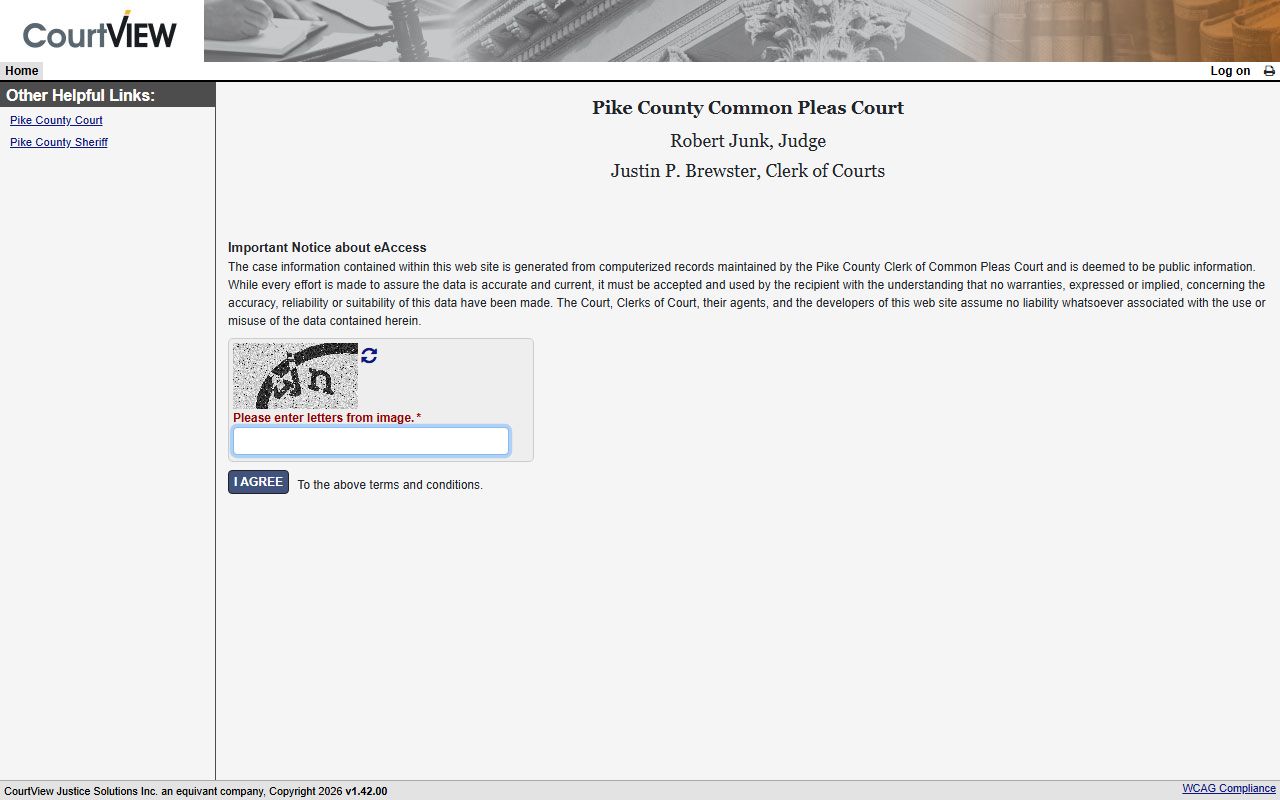
The portal is JavaScript and cookie dependent, so the static research capture did not expose every post-agreement search field.
Pike County Court Search Fields
The Pike County Court search inventory is limited because the public capture reached the CaseLook disclaimer page but did not expose the full search form. That is still important for court records after an arrest because the court itself tells users that the public index has delay and verification limits. When a result affects bond, warrant status, employment screening, a sealing request, or official action, the record should be confirmed with the clerk.
| Field Label | Type | Required | Notes |
|---|---|---|---|
| Agreement / Continue | Link or button | Yes before search | Users must accept the CaseLook disclaimer before searching Pike County Court records. |
| Search fields after agreement | Not exposed in static fetch | Unspecified | The accessible capture did not render the live search UI after the disclaimer. |
| Disclaimer | Notice text | N/A | The court warns of possible delay of at least 24 hours or longer. |
| Clerk verification | Phone or in-person fallback | Required for official reliance | The court directs users to contact or visit the court for verified information. |
The Pike County Court CaseLook disclaimer page is the source for the posting-delay warning and verification fallback.
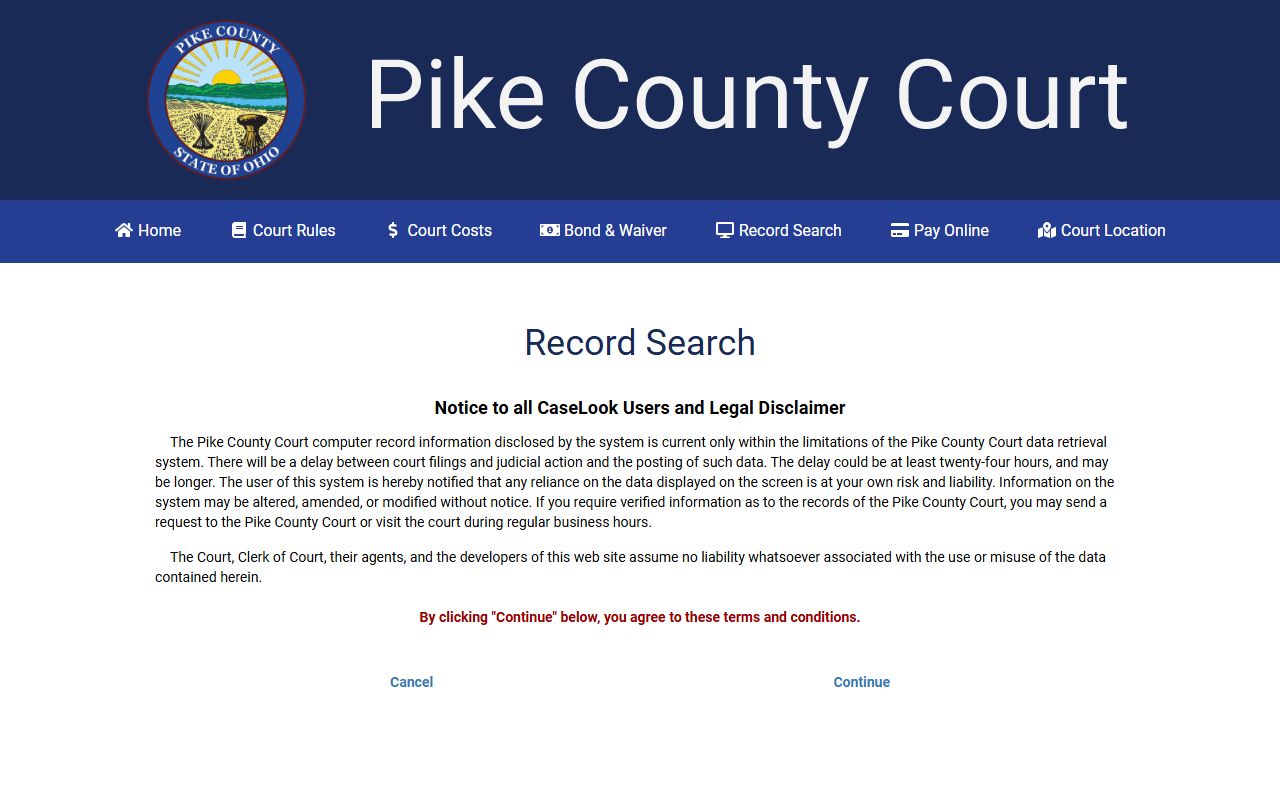
That warning explains why a new jail arrest, a bond change, and a court-record update may not appear at the same moment.
Pike County Arrest Charging Documents
Formal court records after a Pike County jail arrest are built from charging documents. A complaint, information, or indictment is not the same as the short label shown on a jail list. The jail entry captures the arrest or booking side. The charging document is the court paper that frames what the prosecutor or grand jury is asking the court to handle.
| Document | Who Uses It | Common Pike County Role | Why It Matters |
|---|---|---|---|
| Complaint | Officer or prosecutor | Often starts lower-level criminal or traffic cases in Pike County Court. | It states the accused offense and can support first hearings and bond decisions. |
| Information | Prosecutor | Can be used in felony proceedings when allowed by Ohio procedure. | It reflects the prosecutor's formal charge, not just the booking label. |
| Indictment | Grand jury | Common Pleas felony cases may proceed after grand-jury action. | It can replace or supersede an earlier arrest charge. |
Pike County uses the county prosecutor model, not a district attorney title. The Ohio Prosecuting Attorneys Association Pike County page lists Hon. Michael A. Davis at 100 E 2nd Street, S-100, Waverly, OH 45690, phone 740-947-4323. The prosecutor's role is central after arrest because law enforcement submits reports and the prosecutor handles or decides formal charging, especially for felony and serious misdemeanor matters.
Pike County Charge Status
Charges can change as a Pike County case moves through court. The Confinement Manager list may show ORC-style charge references, short offense names, felony or misdemeanor levels, and bond. The court docket is where later case action is tracked. A charge can remain pending, be amended to a different offense, be dismissed, or end in a plea, verdict, or sentence. That is why booking charges should be treated as a starting point, not as a final outcome.
| Status | What It Means | Where to Verify |
|---|---|---|
| Pending | The charge remains active and has not reached final disposition. | Pike County Court or Common Pleas docket, then clerk confirmation. |
| Amended or reduced | The filed charge changed, often through prosecutor action, plea talks, or court order. | The court docket and charging document history. |
| Dismissed | The court case or a specific count was ended without conviction on that charge. | The docket disposition and clerk record. |
| Nolle prosequi | The prosecutor chose not to pursue that charge at that time. | The docket entry and prosecutor or clerk record. |
| Convicted | The case ended in a guilty plea, no-contest finding, or verdict on the charge. | The final judgment entry or sentencing record. |
Note: A Pike County booking charge can look serious, but conviction status depends on the court record, not the arrest label.
Pike County Bond After Arrest
Bond is one of the first court-related items people look for after a jail arrest. The Pike County inmate list may show a bond column with dollar amounts or "NO BOND," but that public entry is only a clue. The Pike County Court Bond and Waiver Schedule states that its schedule was established under Ohio Criminal Rule 46 for criminal and traffic cases and became effective August 14, 2025. It also states that House Bill 1 adds a $25 surcharge to every surety, cash, and 10% bond posted.
| Bond Type | How It Works | Pike County Caution |
|---|---|---|
| Cash bond | Money is paid directly as ordered by the court. | Verify the current amount before posting because the online jail list may lag. |
| Surety bond | A licensed surety or bond agent posts the bond where allowed. | The Pike County Court schedule applies the stated surcharge to surety bonds. |
| 10% bond | The court may allow a deposit of 10 percent of the set bond. | The Pike County Court schedule says the surcharge also applies to 10% bonds. |
| Unsecured bond | No upfront cash is paid, but the person owes if conditions are violated. | Minor misdemeanor entries may use unsecured bond under the court schedule. |
| No-bond hold | No release bond is available at that time. | Probation, APA, detainer, warrant, or judicial no-bond orders can block release. |
The public schedule includes large felony amounts for serious offenses and lower misdemeanor levels, but a schedule is not the same as a live release order. Pike County Corrections and the court should verify bond before anyone pays money, especially when a person may have been transferred to a contracted jail after the local hold period.
Pike County Warrants After Arrest
No official Pike County sheriff active-warrant search was located in the researched sheriff pages. Court records may still show warrant-related entries. The Pike County Court homepage warns law-enforcement officers that any warrant information displayed must be verified by the clerk in person before official action is taken. That warning is unusually direct and should shape how warrant data is read after arrest.
An arrest warrant authorizes arrest. A bench warrant is issued by a judge, often after a missed court date or violation of a court order. A search warrant authorizes a search of property and is not the same as a jail-arrest warrant. Roster examples can also include failure to appear, probation violation, probation detainer, or Adult Parole Authority holder language. Once a warrant leads to custody, the person may appear on the inmate list, have bond set or denied, appear in court, or move to a contracted jail if not released from Pike County's holding facility.
Pike County Charges vs Convictions
A charge is an accusation. A conviction is a court outcome. That difference is basic, but it is easy to lose when a court record follows a jail arrest and the public sees charge text before the case is resolved. Pike County court records should be read by stage, with the docket and final judgment carrying more weight than the first roster entry.
| Point | Charge | Conviction |
|---|---|---|
| Stage | Filed or alleged after arrest, booking, complaint, information, or indictment. | Entered after plea, verdict, or finding. |
| Meaning | The government alleges a crime or violation. | The court has accepted or found guilt on an offense. |
| Proof level | Can begin from probable cause or charging decision. | Requires plea, verdict, or court finding under criminal procedure. |
| Public record risk | May still be pending, amended, or dismissed. | May affect sentence, fines, supervision, and later ODRC records. |
Sealed vs Expunged Records
Ohio law treats sealing and expungement as record-clearing paths for eligible cases, but they are not the same as deleting every trace on demand. Ohio Revised Code 2953.32 governs applications to seal or expunge eligible conviction records, subject to exclusions and court procedure. Dismissed cases, acquittals, and certain convictions may have different eligibility routes and timing. The court order is the key event.
| Point | Sealed | Expunged |
|---|---|---|
| Public visibility | Hidden from routine public court access when the order applies. | Destroyed, deleted, or treated as no longer existing as allowed by statute. |
| Agency access | Certain agencies may still have limited lawful access. | Access is more limited, but depends on the statute and order. |
| Who decides | The court decides after application and statutory review. | The court decides after application and statutory review. |
| Booking-photo effect | May support requests to update official records after a court order. | May support requests to remove or suppress official records if the order covers them. |
Ohio public records law also matters. ORC 149.43 gives public access to records kept by public offices unless an exemption applies. Juvenile records, confidential law-enforcement investigatory records, medical records, and sealed records may be restricted. A Pike County court record after an arrest can therefore be public at one stage and restricted later if a valid court order changes access.
Restricted Pike County Court Records
Not every record tied to a Pike County jail arrest is open in the same way. Juvenile matters, sealed cases, expunged records, medical information, certain victim information, protected personal data, and confidential investigatory material can be withheld or redacted. The Ohio Attorney General's public records explanation states that requesters generally do not need to live in Ohio, identify themselves, or state a purpose as a condition of making a public-records request, but exemptions still apply.
Important: Pike County Inmate Population is not a consumer reporting agency and court or jail data must not be used for FCRA-covered decisions.
When the record must be exact, go to the office that created it. Pike County Court is at 230 Waverly Plaza, Suite 900, Waverly, OH 45690, phone 740-947-4003. Pike County Common Pleas and the Clerk of Courts are at 100 E 2nd Street, Waverly, OH 45690, 2nd Floor, phone 740-947-2715. The prosecutor's office is in the same courthouse complex at 100 E 2nd Street, S-100. Court staff can verify court records after an arrest, while Pike County Corrections and Records handle jail custody, transfer, and booking-record questions.